Thursday, November 15, 2012

Pima Air & Space Museum

Another FOURSDAY and another road trip and today, Tito's dream activity is being realized. 

We venture out to Tucson, Az where the Pima Air & Space Museum has over 400 displays of American Military aircraft, Nasa Space items and other unusual and rare exhibits including a few Soviet built MiG fighters. Later in the day, we take a bus tour of the AMARG Aviation Graveyard where over 4,000 military airplanes and helicopters are stored or dismantled for resale, recycle or demolition. AMARG (Aerospace Maintenace and Regeneration Group) boasts that it is the only US military department that actually makes money.

Entrance into the Pima Air & Space Museum


Let me start by saying that Yvonne and Sandi should be commended for being such good sports about today. Their retaliation day will certainly come.
I will only post a few of the photos I took and only those I found to be most interesting.

This Lockheed SR-71A is, by far,  the most impressive plane on display.  The "Blackbird" was a CIA operated 2-seater Spy Plane capable of speeds over Mach 3. It set a speed record of 2,193 mph and altitude record of 85,069 ft. Quite impressive for the 1970's. In 1990 it flew from New York to London in 1 hr - 55 min - 42 sec.  It was a gas guzzler and could only fly for 1.5 hrs without nursing from a flying fuel tanker.

The U.S. Air Force has been flying the F15A since 1970 and is only now starting to replace them with with the F22 Raptor. Rob and Julie, our friends here at Leisure World,  have a son who flies this type of fighter jet. I found that if you want to know anything about fighter aircraft just ask Rob or Julie.

That innocent looking little item on the dolly in front of the F4 Phantom is actually an unarmed nuclear bomb.

The MiG-23 was the Soviet Unions answer to American fighters such as the F4 Phantom in the previous picture. The Soviets built over 5000 of these MiG 23s.

This is an OV-1 Mohawk that was used for battlefield observation in the 1960's Vietnam war. They are normally equipped with only cameras and infra-red sensors but sometimes do carry armaments. As the story goes, a US pilot got very lucky while taking pictures and he shot down a Soviet MiG after it first attacked him and then inadvertently flew right into his gun-sights.

This odd looking helicopter is a Sikorsky CH-54 SkyCrane. 

Image from Wikipedia
 SkyCranes left military service in the 1990s and are now widely used as Heavy Lift helicopters for erecting electrical towers, fighting forest fires and extracting timber from remote areas. They can fly at 30,000 ft and can lift up to 20,000 lbs.

Various flag markings displayed on a F4 Phantom fighter.

This photo and the following one were downloaded from the AMARG website.  They show a small portion of the 4000 aircraft in storage at the Military Aviation Graveyard near Tucson. 
The aircraft are divided into two basic groups. Flyable and Un-flyable. Flyable means they can be made flyable. These are usually up for sale to friendly foreign nations or sometimes they might even end up in museums or displays. Un-flyable aircraft are usually destined to become spare parts for flyable aircraft. Whatever is left over will go to the shredder.

And finally, a glimmer of hope for the future. These B52 bombers are heading for the shredder but not because they are un-flyable.
Under the 2011 U.S. - Russian New-START Treaty, hundreds of B-52's like these, amongst other types of nuclear missile launchers, are being eliminated from the U.S. active arsenal.

This small airplane is equipped with a radar dome on it's back.  Our tour guide told us a funny story about this airplane. Apparently a lady reported that an airplane was being abducted by a Flying Saucer when she saw this unusual airplane taking off from the airport. 

We ended our day with Fajitas and Enchiladas at a Mexican restaurant called On the Border.  

Great choice for Foursday Tito. Now we have plenty of ammunition for our next encounter with Rob and Julie.


Monday, November 12, 2012

Estate Sale Cactus

Around here organizations like the Kiwanis and Lions Club look after most estate sales.  They're great organizations but I suspect that by the time they open the doors to the public every member has had a chance to go through the loot and snatch up all the cool tools. 

Sometimes a deal can be had if you simply look where nobody else does. Today there are no tools so I walked around the outside of the house and I spotted a potted cactus on the far side of the house.  Once inside, I asked about the cactus and nobody even knew it was there. I offered $10 for it.  I think I could have offered less but I'm a giving person and the Kiwanis do good things for the community.

With Wikipedia's help I discovered the cactus I picked up was an Argentine Hedgehog, also known as a Red Torch because of the spectacular Springtime blooms, but I'm not positive.  We'll see if it survives the transplant or if it even flowers.

So how do you handle a cactus of this size to transplant it? You have to be creative and very careful. Gloves are useless, the needles are an inch long and there are hundreds of them. As careful as I was I still managed to get punctured twice.  Not bad says Yvonne but she only had to hold the pot. I used some nylon tie-down straps and now my straps are full of needles. 

Well, the cactus has found a new home in our back yard right between the Totem Pole (left) and Mexican Fenceposts (right) and the pot is being used on our front patio. Today, the estate sale experience was good for me.

This is a photo of an Argentine Hedgehog I downloaded from Wikipedia. Hopefully it's what we have. It will flower either Red or Orange next March if it is. 

In Alberta, we have weeds growing in the yard. Here, weeds are scarce.  We have a gravel yard and these prickly little guys keep popping up. This one is only an inch tall and I'm leaving it grow to see what it develops into.  It's too small right now to identify.


Wednesday, November 7, 2012

We visit Biosphere 2

IT'S FOURSDAY and it's Yvonne's choice. Being a former school teacher, she just had to pick something educational. Today will be a science lesson.

We arrive at the Biosphere2 compound after a two hour drive from Mesa and the first question on everybody's mind is..... What was Biosphere 1? Well, it's the Planet Earth of course, says our tour guide.  I'm positive I saw this Dharma crest on his overalls.

Biosphere 2 was an attempt at a miniature re-creation of our planet. A self-sustained world in a test tube with an artificial rain forest, deserts, savannahs, farms and even a miniature ocean. A prototype for colonizing the Moon or Mars after it was feared by some very rich people that human beings were on a self destruction course. 
In 1991, 5 years after construction began and after 150 million dollars were spent, four men and four women along with 4000 species of plants and animals, including chickens, goats and pigs were sealed inside for a two year period during which time they had to grow their own food, recycle their own waste and water and maintain the facility to keep their fragile little ecosphere in balance. I'll tell you later how that turned out.

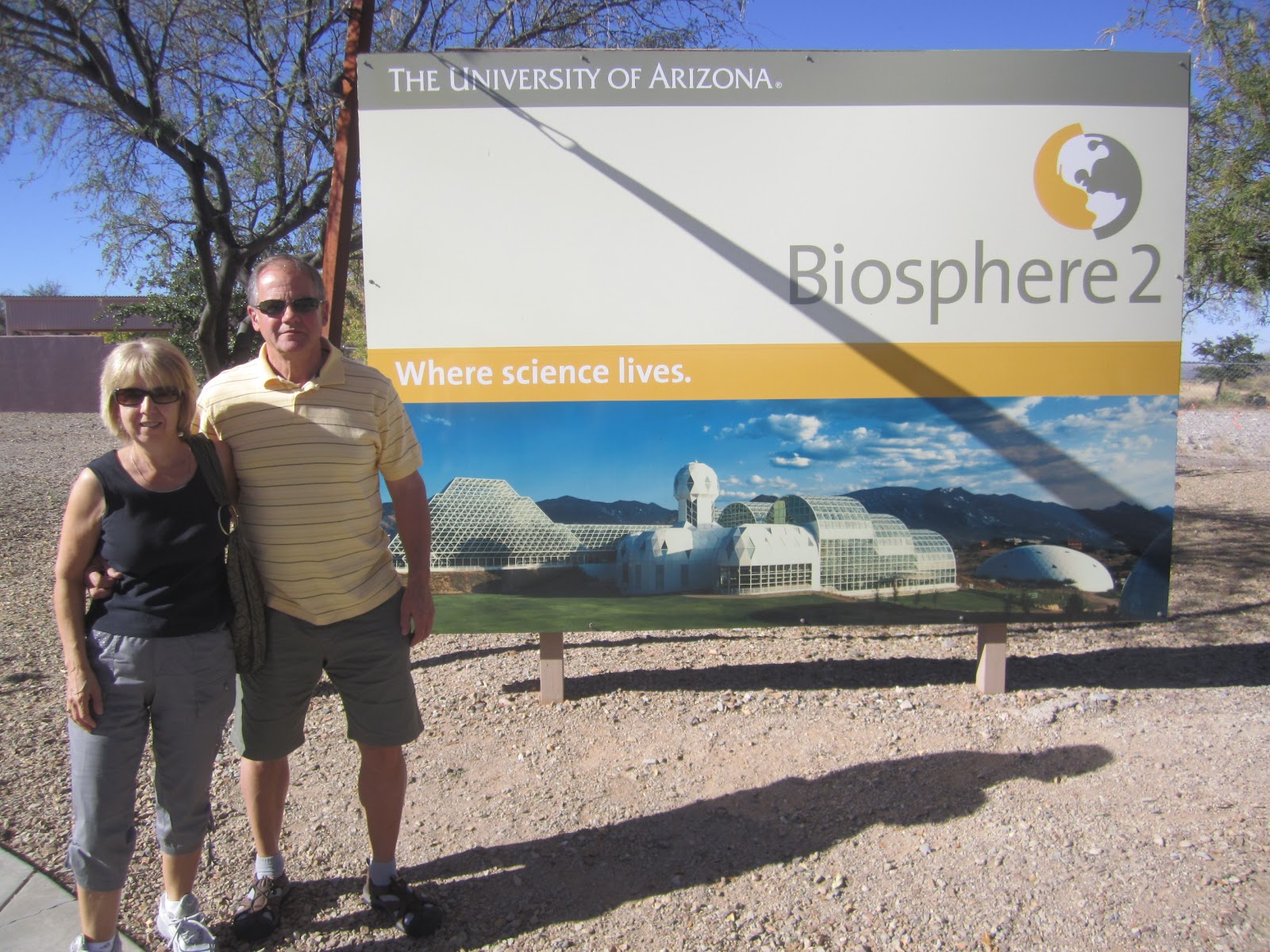
Sandi &Tito
Yvonne & Robert
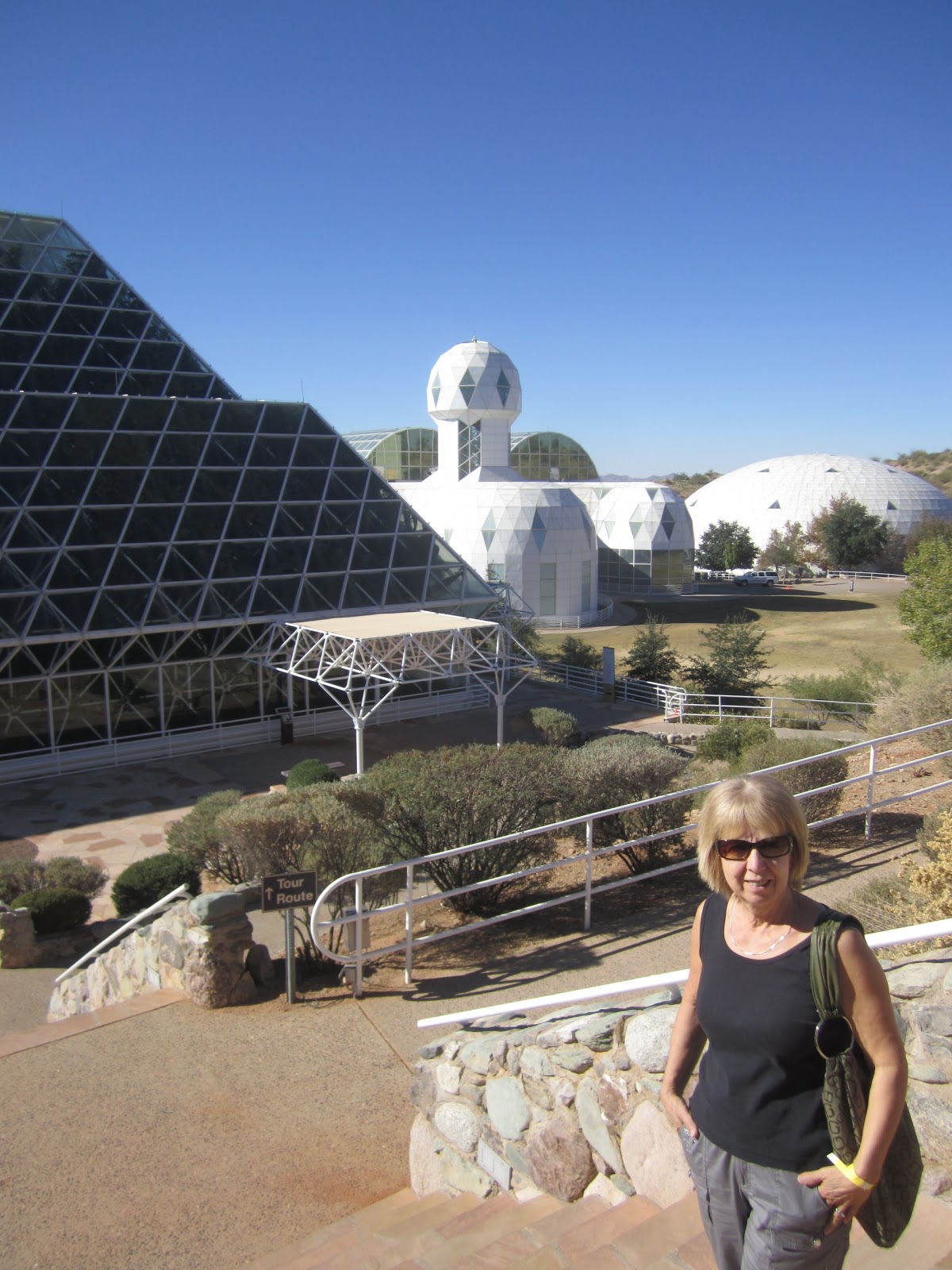
The setting is the Sonoran Desert near Oracle Arizona with the Santa Catalina Mountains in the far background. When you see it for the first time, the Biosphere looks like something from a James Bond movie.  A gigantic glass structure resembling a Mayan pyramid surrounded by other huge and mysterious glass and metal domes.
Today, the four of us are going to figure this place out and at the end I will try to summarize everything in 100 words or less.


Biome is a cool word they use around here so I'll use it too, whenever I can.  The Biosphere's Rainforest biome is on the left, the living quarters are in the centre and that low dome-like structure on the right is something named the West Lung. There's another identical dome behind all of this and it's named the South Lung.

This is the main entrance into the Biosphere. It is an air-lock chamber and has sealable doors similar to those on a ship. From here on we are confined to the same spaces the 1991 Biospherians had access to.

This stairway leads to the sphere-shaped library perched above the living quarters. The eight inhabitants had access to the library during their stay.

Inside the Rainforest biome.


Our tour guide led us underground into a windy passageway connecting the Desert biome to the South Lung.

I had a Twilight Zone flashback while standing inside one of the giant mechanical lungs
During the closure experiments when researchers were sealed inside for long periods, Scientists needed a way to accommodate for the daily expansion and contraction of the air mass trapped within the Biosphere. The trapped air mass would expand during daytime heating and contract during night time cooling.  Calling them "lungs" is a bit confusing because it implies that their function is to somehow purify the air when in fact, all they do is allow for the trapped air mass to expand and contract freely without exerting pressure (positive and negative) on the external walls of the Biosphere structure. The round suspended disc in the centre would simply float up and down allowing air free movement in and out of the lung as if it was breathing.

Here is a better view of the rubber membrane of the lung in the expanded position. In the contracted position the legs rest on the floor.

The 750,000 gallon Ocean biome is over 25 feet deep and has a coral reef and salt water fish. 

This is the kitchen and eating area the Biospherians used during their closure experiment. The spiral staircase leads up to sleeping quarters.

Living quarters behind the kitchen with stairs leading up to bedrooms.

These buildings make up the Energy Center. It's where the Engineers, Maintenance and Facility Managers monitor the activities inside the Biosphere2.  Behind these buildings are two gas fired electrical generators. Initially the Biosphere2 Project generated it's own power. Today, they buy electricity but still remain capable to go off the grid if need be.

These three domes were originally used as "farms" where the inhabitants grew their own vegetables and crops. Today they are part of a Water & Life Experiment where soil-erosion experiments are conducted by the new owners, The University of Arizona.

Back then it was ants and cockroaches that outnumbered the captive people. Of course today, it's tourists that overrun the place.

The Biosphere experiment is often called a successful failure. Scientists involved with the project say that the venture was a success because of what was learned about sustainable living and I suppose that's true. That's what research is all about and sometimes success is hard to measure. The facility remains an exceptional laboratory for addressing critical questions relative to the future of Earth and it's environment.

Critics say it was a waste of money and too much went wrong with the experiment to call it a success.

So what did go wrong with Biosphere2? From the onset, the inhabitants noticed and experienced the effects of a gradual drop in oxygen levels. After 16 months, the oxygen level was down to 14.5% from the normal 20.9%.  Coincidently, they noticed a rise in carbon dioxide.  The inhabitants were becoming increasingly sick. Unforeseen by the designers was the role and effect that huge amounts of exposed concrete was having in the confined space. Excess carbon dioxide was reacting with the concrete to form calcium carbonate, thereby sequestering available carbon and oxygen. By the time the scientists had figured this out they had already introduced supplementary oxygen to keep the inhabitants and atmosphere from further deterioration.  By then 19 of the 25 introduced insect species including all the pollinator species had died off leaving only ants, cockroaches and katydids to overrun the place.  The ants, local to the area, had been inadvertently introduced and sealed in during construction and had grown to dominate over the other insects. There was conflict among the inhabitants which resulted in two groups being formed that wouldn't talk to each other. The management team often had conflicting views as well. And on top of all that, one night while everyone slept, the pigs got into the garden and destroyed it.

Today the Biosphere is a research facility owned and operated by the University of Arizona.  It also houses a conference centre including housing facilities and it caters to the tourist industry making it possible for people like us to visit and pass judgement.
  

Wednesday, October 31, 2012

Back to the Desert, but first....

This year our trek South took us through Southern BC and down the coast of Oregon and California. We stopped to visit Joel, Erin and the kids for a couple days while passing through BC. Amy flew in from Vancouver to complete the family reunion. 

Once we crossed the border into the States we planned to hook up with Sandi and Tito for the rest of the trip to Arizona.

Our first detour was just west of Rocky Mountain House Alberta. A collision closed the hiway and all traffic was directed away along meandering oil-lease roads and heavily treed forests.


From the Saskatchewan River Crossing North of Lake Louise to Field BC we drove in winter-like conditions. Four inches of heavy slush on the road ready to pull you into the ditch.


Whenever we drive to Joel's from Alberta we always try to be in Revelstoke around noon BC time so we can catch the 3 o'clock Galena ferry. We arrived in Golden behind schedule only to be delayed by another traffic accident. This one on the Rogers Pass.  Local radio broadcasts were not encouraging. The road to Revelstoke was expected to be closed for at least 4 more hours and the confidence level was low. Golden was becoming plugged up with long lines of transport trucks and hundreds of cars. People were parking everywhere, waiting for the police to re-open the road.  Seeing all this we decided to head back towards Radium Hot Springs and then South to Creston. The detour would take us 200 kms off course but the alternative was to wait and continue on to Revelstoke in that traffic glut. That would be too slow and unpredictable.

Finally we arrive at Joel's. Let the fun begin!

We all pitched in to cook the perfect seafood supper.

Plenty of things to do when you have a 30 acre yard. However,  time was tight on this trip and we had to leave after only two days. We dropped Amy off at the Castlegar Airport and we kept going South to meet up with Sandi and Tito in Spokane.

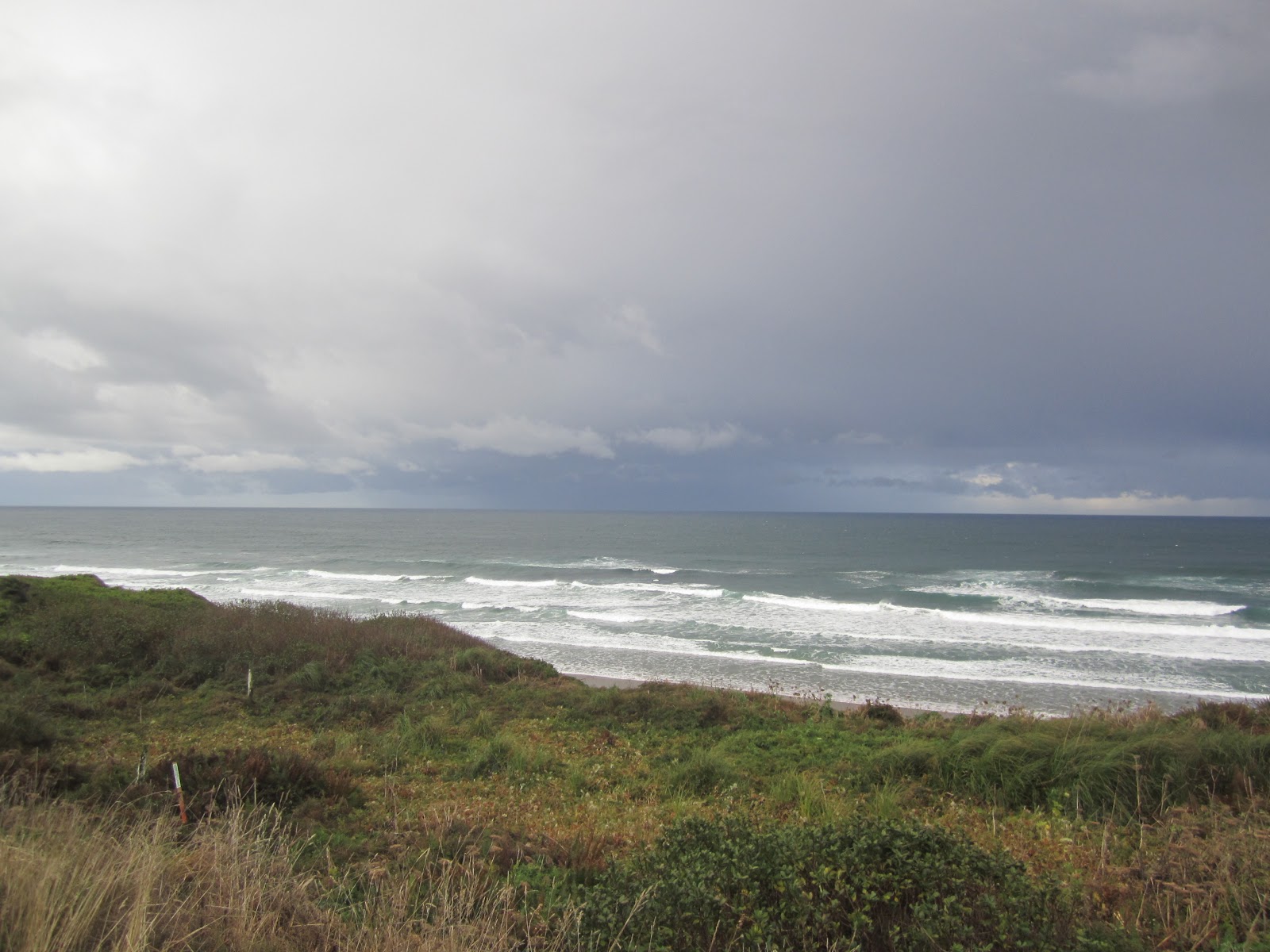
The Oregon coast is beautiful even in the rain. 

The rain finally lets up when we cross into California.

The Redwood Forest in Northern California is truly awesome. 
Some of these trees are apparently over 2000 years old.

I'm sure you could build a small village with the wood from just one of these giants.

Is he still behind us? Don't look!

Houses built in hollowed out redwood stumps. 
Valen and Atti would be impressed.


We stop to observe a huge herd of elephant seals sunning themselves right alongside Highway 101 in Norther California. "These juvenile seals spend time out of the water to build up bone mass" says the guy watching next to us. Apparently floating around in the water doesn't do much for building strong heathy bones. They will be here for a month before leaving and doing other things seals do.

Over the Golden Gate Bridge we go. Our destination today is Carmel by the Sea. Tito's GPS took him through downtown San Francisco while ours skirted most of the city along the western coast route.

Clint Eastwood was the mayor here in Carmel for a while and his presence is still everywhere.

Yvonne and Robert on their hotel balcony.

Best Western Carmel Bay View Inn

A cool and quaint house that caught Sandi's eye.

Sushi, tempura and beer.

California coast view from the truck window.

Yvonne found the perfect rock to relax on. This is Pismo Beach and that building on the cliff in the background is our hotel for the day. The Shelter Cove Inn.

Check out the temperature reading in the mirror as we approach Phoenix Az.


The summer was kind to our home away from home despite some 110F weather, dust storms and monsoon rains.  Other than a tipped over ocotillo cactus everything was as we left it 6 months ago.